
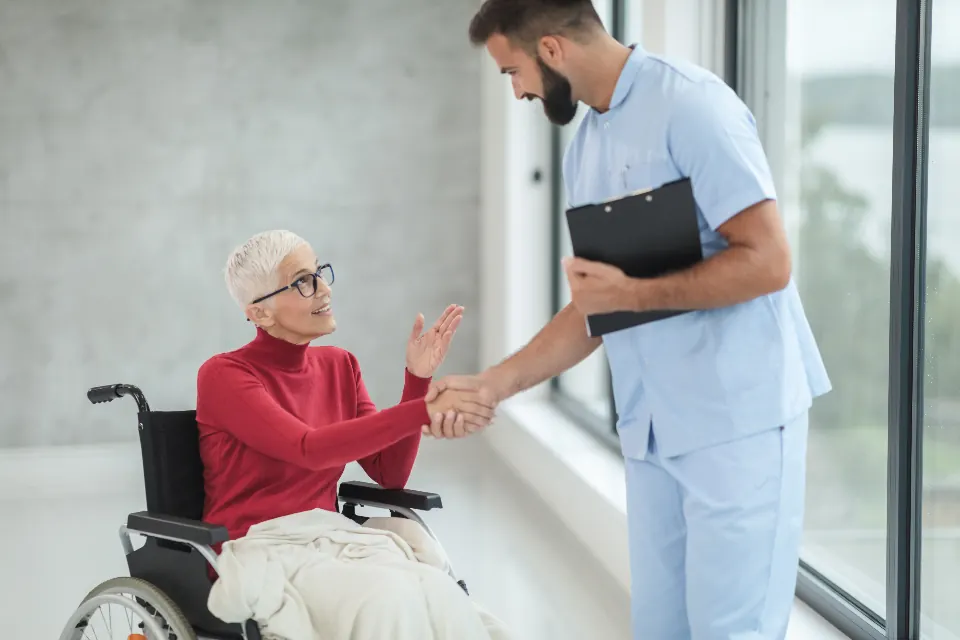
A CNA, or certified nursing assistant, does much of the hands-on care in nursing homes and a good share of it in hospitals: bathing, dressing, moving and feeding patients, taking vital signs, and telling the nurse when something looks wrong. You become a CNA by finishing a state-approved training program and passing your state's competency exam, which puts your name on the state's nurse aide registry. That part works the same way everywhere. What a CNA is legally allowed to do does not.
A CNA in Colorado can train to give insulin shots. A medication aide in Texas can hand out pills but can't give an injection of any kind. In Mississippi, the nursing rules keep medications with licensed nurses. This profile covers what a CNA does day to day, what the job pays, where it leads, and how to find out what your own state allows.
Median CNA pay
$42,260
$20.32 an hour, BLS May 2025
Training hours
75 to 175
Federal minimum to the highest state
CNAs employed
1,448,910
BLS, May 2025
Projected job growth
3%
BLS, 2025 to 2035
What Is a CNA?
Federal law calls the job "nurse aide." States use their own titles: Washington's rules say "nursing assistant," North Carolina lists a "Nurse Aide I," and Maryland adds a separate geriatric nursing assistant credential for nursing homes. They all describe the same core role, and most people just say CNA.
The standard route to becoming a CNA has two parts: a state-approved training program and a passing score on the state's competency evaluation. Federal rules require the training to be at least 75 hours, with at least 16 hours of supervised practical training where you perform tasks on a real person while a nurse watches (42 CFR 483.152). Once you pass, the state lists you on its nurse aide registry, and the state can't charge you for that listing (42 CFR 483.156). A nursing home has to check the registry before it lets you work as a nurse aide (42 CFR 483.35).
A CNA is not a nurse. RNs and LPNs hold a license. A CNA holds a certification and works under a nurse's direction. Florida's rule says it plainly: a certified nursing assistant "shall not work independently without the supervision of a registered nurse or a licensed practical nurse" (Fla. Admin. Code 64B9-15.002). That supervision is the reason your state's rules matter so much. The nurse can only hand you tasks the state says a CNA may do.
What Does a CNA Do?
The Bureau of Labor Statistics sums up the job as basic care and help with activities of daily living. In practice, a CNA's duties and responsibilities look like this:
-
Bathing and cleaning patients, including perineal care
-
Helping patients use the toilet or a bedpan, and dressing them
-
Turning, repositioning and transferring patients, often with a gait belt
-
Measuring vital signs: temperature, pulse, respirations, blood pressure
-
Serving meals and helping patients eat and drink
-
Listening to patients' health concerns and recording them
-
Noticing changes (a new bruise, a patient who stops eating) and reporting them to the nurse
Federal training rules add the parts of the job that don't show up on a task list: communication, infection control, residents' rights, caring for people with dementia, and restorative care like range-of-motion exercises (42 CFR 483.152(b)). Those are what separate a CNA who just gets tasks done from one a nurse trusts.
What a CNA Shift Looks Like
On a nursing home day shift, you start with report from the night CNA: who had a rough night, who's refusing breakfast, who has a doctor's appointment. Then it's morning care. You get residents up, washed, dressed and to the dining room, or you set up trays for the ones who eat in bed. Some need help cutting food. Some need you to feed them one spoonful at a time.
Between meals you're answering call lights, walking residents to the bathroom, turning bed-bound residents so they don't develop pressure sores, and taking vital signs for the nurse. You write down what they ate and drank. When a resident who's usually chatty goes quiet, or a blood pressure reading looks off, you tell the nurse right away. That report is one of the most important things a CNA does, because you see residents far more often than anyone else on the team.
It's physical work. You're on your feet, lifting and moving people all shift. And it's personal. You'll help people at their most private moments, and in long-term care you'll care for people at the end of their lives. Texas's CNA exam outline even includes post-mortem care (Texas CNA candidate bulletin).
What Does a CNA Do in a Hospital, a Nursing Home or Home Care?
The core duties are the same everywhere. The pace, the patients and the rules around you change. Here's where nursing assistants work and what each setting pays at the median, from the BLS Occupational Outlook Handbook:
-
Nursing homes
Nursing care facilities (skilled nursing)
$43,000
36% of CNA jobs
$740 above national
-
Hospitals
Hospitals (state, local and private)
$42,310
32% of CNA jobs
$50 above national
-
Assisted living
Continuing care retirement communities and assisted living
$39,490
11% of CNA jobs
$2,770 below national
-
Home health
Home healthcare services
$38,040
5% of CNA jobs
$4,220 below national
-
Government
Government
$47,050
3% of CNA jobs
$4,790 above national
-
All CNAs
Every setting, nationally
$42,260
100% of CNA jobs
National median
Government excludes state and local education and hospitals. BLS figures for 2025.
In a Nursing Home
Nursing homes are the biggest employer and the setting the federal CNA rules were written for (CMS, April 2026). You care for the same residents week after week, which means you learn their habits and notice when something changes. Federal rules require a nursing home to give every nurse aide at least 12 hours of in-service training a year, including dementia care and abuse prevention (42 CFR 483.95(g)). Texas, Florida and Maryland all have medication aide roles built for nursing homes.
In a Hospital
Hospitals employ about a third of nursing assistants. Patients come and go faster, they're often sicker, and you work alongside more nurses and doctors. What does a CNA do in the hospital? Mostly the same care, at a quicker pace: vital signs on a schedule, helping post-surgery patients get up and walk, turning patients, and keeping the nurse informed. Some expanded tasks states allow elsewhere stop at the hospital door. Washington's insulin delegation program, covered below, excludes acute care hospitals by law.
In Home Care
In home health you go to the patient instead of the other way around, and there's usually no nurse in the room. Medicare-certified home health agencies have their own federal aide training rule, and a CNA who is in good standing on the state registry meets it (42 CFR 484.80). Home care is the lowest-paying setting in the BLS table. It's also one of the settings where Washington's delegation rules, covered below, apply.
CNA Scope of Practice: Why It Changes from State to State
Strictly speaking, a CNA doesn't have a license, so CNA scope of practice really means the list of tasks a nurse is allowed to hand you. Each state writes that list in its own nurse practice act and board of nursing rules. The national delegation guidelines from the National Council of State Boards of Nursing and the American Nurses Association say so directly: states "have different laws and rules/regulations about delegation," and every licensed nurse has to know what their own state permits (NCSBN and ANA, 2019). The same guidelines say an employer's policy can be more restrictive than state law, but never less. So your hospital can tell you not to do something your state allows. It can't tell you to do something your state forbids.
The biggest dividing line is medications. When the American Nurses Association compiled a state-by-state chart in September 2015, it counted 36 states that had created some kind of medication aide role (ANA state chart). Those roles look very different from state to state. Here are seven states whose rules we read at the source:
Extra Certifications by State: Medication Aide, Insulin and Nurse Delegation
| State | Step up from CNA | Extra training | What it adds | Hard limits |
|---|---|---|---|---|
| Texas | Medication aide permit | 140-hour program, after working as a nurse aide | Regularly prescribed medications, including eye, ear, nasal, rectal and vaginal | No injections of any kind, no dose calculations, no phone orders |
| Florida | Qualified medication aide (nursing homes) | 6-hour course plus a 34-hour course, after 1 year certified | Oral, skin-patch, eye, ear, inhaled and topical medications, blood glucose checks, oxygen settings, CPAP help | Direct supervision by a licensed nurse, no Schedule II to IV controlled substances |
| Colorado | CNA with Medication Aide Authority (CNA-Med) | 1,000 hours of CNA work in 24 months, then a 100-hour course | Most oral and topical routes, feeding-tube medications, subcutaneous insulin | No other injections, can't take verbal or phone orders |
| Maryland | Geriatric nursing assistant (GNA), then certified medicine aide | GNA exam, then 1 year as a GNA and a 60-hour community college course | GNA is required to work in a nursing home, medicine aide to give medications there | Medications in nursing homes require the medicine aide credential |
| North Carolina | Nurse Aide II | Board of Nursing-approved NA II course | Sterile dressing changes, urinary catheterization, trach care, suctioning, tube feedings | An RN validates your skills and a nurse decides patient by patient |
| Washington | Nurse delegation | Core delegation training, plus diabetes training for insulin | Insulin injections and other delegated tasks | Only in adult family homes, assisted living, disability residential programs and clients' homes |
| Mississippi | None for medications | None | Nothing on the medication side | RNs may assign medication administration to licensed nurses only |
Texas: Medication Aides Since 1979
Texas has let medication aides work in nursing homes since 1979, according to the ANA's state chart. To get a permit today you need to be at least 18, have a high school diploma or GED, have worked as a nurse aide in a Medicare or Medicaid nursing facility (or 90 days as non-licensed direct care staff) in the year before training, and finish a 140-hour state-approved program (Texas HHS). The rule then draws firm lines. A Texas medication aide may not give medication by injection, whether into a muscle, a vein or under the skin, may not calculate a dose, and may not take a verbal or telephone order from a doctor (26 TAC 557.105).
Florida: Medication Tasks by Delegation, with a Nursing Home Tier
Florida lets an RN delegate medication administration to a CNA who finishes a 6-hour board-approved course and is found competent. In a nursing home that covers oral, transdermal, eye, ear, inhaled and topical prescription medications. For home health patients the list adds rectal and enteral (feeding tube) routes (Fla. Stat. 464.2035). To do this in a nursing home, you also need at least a year of clear certification and a 34-hour course that covers blood glucose checks, setting oxygen flow meters and helping with CPAP machines. Once you've done that you're a qualified medication aide, and you can give medications only under the direct supervision of a licensed nurse (Fla. Stat. 400.211).
Colorado: Experience First, Then Insulin
Colorado's CNA-Med needs real experience first: at least 1,000 hours of documented work as a CNA in the last 24 months and a written recommendation from your supervising nurse, director of nursing or administrator. The training is at least 100 hours, with 60 in the classroom and lab and 40 clinical (3 CCR 716-1.12). In return, a CNA-Med can give medications by mouth, under the tongue, in the eye, ear and nose, rectally, vaginally and through the skin, through G-tubes, J-tubes and NG tubes, and subcutaneous insulin by syringe, pen or pump after checking with the supervising nurse (3 CCR 716-1.18). An RN generally supervises, and when no nurse is on site you need prompt phone access to one.
Maryland and North Carolina: Tiers Inside the CNA Credential
Some states split the job into levels. In Maryland, CNA certification is the base, and a geriatric nursing assistant (GNA) credential is required for every nursing assistant working in a licensed nursing home. Giving medications there takes a third credential, certified medicine aide, open only to a GNA with a year of experience who completes an approved 60-hour course at a community college (Maryland Board of Nursing). Maryland's rules also list home health, school health, dialysis technician and developmental disabilities as separate CNA categories (COMAR 10.39.01.09).
North Carolina splits it differently. Nurse Aide I is the entry level. Nurse Aide II, set by the Board of Nursing, covers tasks that go well past basic personal care: sterile dressing changes, urinary catheterization, tracheostomy care, oral and nasal suctioning, ostomy care, gastrostomy feedings, and helping with peripheral IV fluids (setting up tubing, monitoring the flow rate, discontinuing the infusion). An RN has to validate your competence before delegating any of it (NC Board of Nursing).
Washington: a Narrow Door for Insulin
Washington lets an RN delegate tasks to a registered or certified nursing assistant or a certified home care aide, but only in community-based settings (adult family homes, assisted living facilities and residential programs for people with developmental disabilities) and in clients' own homes. The law's definition of an in-home setting excludes acute care and skilled nursing facilities. Injections, sterile procedures and central line maintenance can never be delegated, with one exception: insulin injections for people with diabetes (RCW 18.79.260). Before you can take on insulin you need the core delegation training plus a diabetes-focused course, and the RN has to check your work at least every two weeks for the first four weeks and at least every 90 days after that (WAC 246-840-930).
Mississippi: Medications Stay with Licensed Nurses
Mississippi's nursing rules let an RN assign medication administration "to other licensed nurses only (either a RN or LPN)" (30 Miss. Admin. Code Pt. 2830). The one exception written into the rules is for certified clinical hemodialysis technicians, who may give heparin, saline and lidocaine as part of dialysis (Part 2860). There's no medication aide route for CNAs. A 2026 bill that would have let nurses delegate medication administration to unlicensed staff in outpatient clinics died in committee in February 2026 (HB 1057 history).
Can a CNA Give Insulin? It Depends on the State
Insulin shows how far apart the rules are. You might assume a CNA can never give a shot, and in plenty of places that's right. But look at the same task across five states:
- Texas: no. A medication aide can't give any subcutaneous injection, and insulin is one.
- Colorado: yes, for a CNA-Med, by syringe, pen or pump, after checking with the supervising nurse.
- Washington: only by nurse delegation, only outside hospitals and nursing homes, and only after diabetes training.
- Florida: the Board of Nursing's rule keeps injections outside a CNA's scope except insulin from a syringe a pharmacist prefilled or a pen the manufacturer prefilled (64B9-15.0026), and the nursing home medication aide course covers insulin administration (64B9-15.0025).
- Mississippi: no. Medications go to licensed nurses.
How to Check Your Own State's CNA Scope of Practice
-
Find the rules
Find your state's board of nursing and look for its rules on delegation to unlicensed assistive personnel or nurse aides.
-
Look for a step-up credential
Search the same rules for "medication aide," "medication technician" or "medication assistant" to see if a step-up credential exists.
-
Check the setting
Check which settings a rule covers. A task allowed in assisted living may be off-limits in a hospital.
-
Ask your employer
Ask your employer for its delegation policy. It can be stricter than state law, never looser.
Our state CNA program pages link to each state's approving agency, a good starting point for finding its rules.
Working as an Agency or Travel CNA in More Than One State
Some CNAs work through a staffing agency that sends them into facilities in more than one state, or move and want their certification to carry over instead of starting training from scratch. Federal law anticipates this: before letting you work as a nurse aide, a nursing home must check "every State registry ... that the facility believes will include information on the individual" (42 CFR 483.35(d)(5)), not just the registry of the state the facility sits in. In practice, a facility can and often will look you up in every state where you've been listed, not only its own.
Two federal clocks matter more once you're moving between states or between jobs. First, if you go 24 consecutive months without any paid nursing or nursing-related work, you have to complete a new training and competency evaluation program before working as a nurse aide again (42 CFR 483.35(d)(6)). Second, a state registry has to remove your name after that same 24-month gap in paid work, with one exception that never expires: a documented finding of abuse, neglect or misappropriation of property stays on your record no matter how much time has passed (42 CFR 483.156(c)(2)). Keeping any paid nursing-related work on the books, even occasional shifts, is what keeps both clocks from resetting.
Getting listed on a second state's registry is usually called reciprocity or endorsement. Most states let a CNA in good standing elsewhere skip retraining and retesting, but the paperwork, fees and processing time differ by state. Two examples we read at the source:
- Texas will add you to its registry by reciprocity if you're "currently on the nurse aide registry in another state that is in compliance with applicable federal laws" and you complete the required documentation (Texas HHS, NAR Credentialing FAQs). That means filing Form 5505-NAR with a government ID, Social Security card, a Texas criminal history check, and proof of your current out-of-state certificate. Texas tells applicants to expect several weeks, longer than reciprocity takes in most states.
- California generally accepts a certification from another state without a new competency exam, under the same state rule that governs its own CNA programs (22 CCR § 71801 et seq.). The exception: if your out-of-state certificate is more than two years old, California also asks for proof of recent nursing-related work, such as a pay stub, before certifying you by endorsement.
Our CNA reciprocity guide lays out what each state asks for, what it costs and where you may have to test again.
CNA Skills List: What You're Trained and Tested On
Every state-approved program covers the federal curriculum: communication and interpersonal skills, infection control, safety and emergency procedures, basic nursing skills like vital signs and height and weight, personal care, mental health and social needs, care of people with dementia, restorative care, and residents' rights (42 CFR 483.152(b)).
The skills exam is where it gets concrete. Texas's testing vendor publishes the full list a candidate can be asked to perform (Texas CNA candidate bulletin), and it's a good picture of the hands-on skills a CNA program drills:
-
Handwashing, which is scored on every test without being prompted
-
Walking a resident with a transfer or gait belt, and a pivot transfer from bed to wheelchair
-
Helping a resident use a bedpan, and emptying a urinary drainage bag and recording output
-
Changing bed linen with the resident in bed, and positioning a resident on their side
-
Dressing a resident with a weak arm, and feeding a resident sitting in a chair
-
Measuring and recording a radial pulse and respirations
-
Catheter care and perineal care
-
Mouth care with and without dentures, foot care, and hand and nail care
-
A partial bed bath and back rub
-
Passive range-of-motion exercises for the shoulder, elbow and wrist, and hip, knee and ankle
CNA Salary: How Much Does a CNA Make?
Nursing assistants earned a national median of $42,260 a year, or $20.32 an hour, in the BLS wage survey for May 2025. Entry-level pay (the 10th percentile) was $33,940, and the top 10% earned more than $51,980. BLS counted 1,448,910 nursing assistants nationwide.
Where you live moves that number a lot. Here are the five highest and five lowest state medians. Each state name links to its program page, and our CNA salary by state page ranks every state, with pay by setting and what BLS leaves out of these figures:
Highest median CNA pay
Lowest median CNA pay
24 of the 51 states in the survey (DC included) pay above the national median. Setting matters too: in the BLS table above, government and nursing home jobs paid more at the median than home health. A median is a midpoint, not an offer, so check real postings near you.
The job outlook is steady rather than explosive. BLS projects nursing assistant employment to grow 3 percent from 2025 to 2035, about as fast as the average for all occupations (BLS).
CNA Career Path: Medication Aide, LPN, RN
A CNA certification is a starting point, not a ceiling. There are three common steps up from it, and the first one only exists in some states. The cards below compare the CNA with the two licensed nursing roles. For their full pay ranges, job growth and yearly openings side by side, see the CNA vs LPN vs RN salary comparison.
-
Certification
CNA
$42,260
Median pay (BLS, May 2025)
- Training
- 75 to 175 hours, depending on state
- Exam
- State competency exam (written or oral, plus skills)
-
License
LPN / LVN
$64,400
Median pay (BLS, May 2025)
- Training
- Certificate or diploma, about 1 year
- Exam
- NCLEX-PN
-
License
RN
$97,550
Median pay (BLS, May 2025)
- Training
- Associate degree, bachelor's degree or hospital diploma
- Exam
- NCLEX-RN
CNA to Medication Aide
If your state has a medication aide credential, it's the quickest step up. The training is 40 hours in total for a Florida nursing home, 100 hours in Colorado and 140 in Texas. All three want CNA work experience first, and Colorado's 1,000-hour requirement works out to about half a year of full-time work before you can enroll.
CNA to LPN
LPN programs are usually certificates or diplomas at community colleges and technical schools, and they typically take about a year (BLS). You finish by passing the NCLEX, the national nurse licensure exam run by the National Council of State Boards of Nursing. LPNs earned a $64,400 median in May 2025. Your CNA work also gives you something a lot of nursing students don't have: you already know what a full shift of patient care feels like.
CNA to RN
RNs earn the most of the three, with a $97,550 median in May 2025, and BLS projects 6 percent growth from 2025 to 2035. You can get there with an associate degree in nursing, a bachelor's (BSN) or a hospital diploma program, then the NCLEX-RN. Some CNAs go straight to an RN program and some go CNA to LPN to RN, working as an LPN while they finish. When you're comparing programs that describe themselves as a "CNA to RN bridge," check exactly which prerequisites your CNA certification replaces, if any.
Is CNA a Good Career? Pros and Cons
It depends on what you want from it. These are the trade-offs.
What's Good About Being a CNA
- It's fast. Training is 75 hours in 23 states. You can be working in weeks, not years.
- Training can be free. If a nursing home employs you or has offered you a job on the day your training starts, federal rules say you can't be charged for any part of it. If you pay and a nursing home hires you within 12 months of finishing, the state has to reimburse you, pro rata, while you work there (42 CFR 483.152(c)).
- The jobs are everywhere. About 1.45 million nursing assistants work in hospitals, nursing homes, assisted living and home care.
- It's a real on-ramp to nursing. You'll know whether you want to be a nurse before you spend years in school.
What's Hard About Being a CNA
- The pay is modest. The national median is $42,260, and in Louisiana it's $30,510.
- It's hard on your body. BLS says nursing assistants and orderlies "have one of the highest rates of injuries and illnesses of all occupations," mostly from moving patients (BLS).
- The schedule follows the patients. Care runs around the clock, and BLS notes nursing assistants may need to work nights, weekends and holidays.
- It's emotionally heavy. You'll care for people who are very sick, confused or dying, and it's hard not to get attached.
If you want to try nursing without betting years of tuition on it, being a CNA is a low-cost way to find out. If you're looking for high pay right away, it isn't.
CNA FAQ
What is a CNA?
What can a CNA do, and what can't a CNA do?
Can a CNA give medications?
Does CNA scope of practice vary by state?
Is a CNA a nurse?
How long does it take to become a CNA?
What does a CNA do in a hospital?
Do CNAs have to renew their certification?
Sources
Every source below was checked on September 24, 2026.
- Occupational Outlook Handbook: Nursing Assistants and Orderlies. U.S. Bureau of Labor Statistics.
- Occupational Employment and Wage Statistics (OEWS), May 2025. U.S. Bureau of Labor Statistics.
- 42 CFR § 483.152, Requirements for approval of a nurse aide training and competency evaluation program. Cornell LII.
- 42 CFR § 483.156, Registry of nurse aides. Cornell LII.
- 42 CFR § 483.35, Nursing services. Cornell LII.
- 42 CFR § 483.95, Training requirements. Cornell LII.
- 42 CFR § 484.80, Condition of participation: Home health aide services. Cornell LII.
- QSO-26-08-NH: Clarification regarding NATCEP and CEP requirements and allowable flexibilities (April 8, 2026). Centers for Medicare & Medicaid Services.
- National Guidelines for Nursing Delegation (2019). National Council of State Boards of Nursing and American Nurses Association.
- Medication Aide / Technician Categories by State (September 2015). American Nurses Association.
- Become a Medication Aide in Texas. Texas Health and Human Services.
- 26 Tex. Admin. Code § 557.105, Allowable and Prohibited Practices of a Medication Aide. Cornell LII.
- Texas Certified Nurse Aide Candidate Information Bulletin. Prometric (Texas nurse aide testing vendor).
- Florida Statutes § 464.2035 (2025), Administration of medication. The Florida Senate.
- Florida Statutes § 400.211 (2025), Persons employed as nursing assistants; certification requirement; qualified medication aide designation and requirements. The Florida Senate.
- Fla. Admin. Code R. 64B9-15.002, Certified Nursing Assistant Authorized Duties. Cornell LII.
- Fla. Admin. Code R. 64B9-15.0025, CNA Medication Administration. Cornell LII.
- Fla. Admin. Code R. 64B9-15.0026, Medication Administration Outside the Scope of Practice of a CNA. Cornell LII.
- 3 CCR 716-1.18, Rules for the Certified Nurse Aide in Relation to Medication Aide Authority. Cornell LII.
- 3 CCR 716-1.12, Rules for Approval of Medication Aide Training Programs. Cornell LII.
- RCW 18.79.260, Registered nurse: activities allowed, delegation of tasks. Washington State Legislature.
- WAC 246-840-930, Criteria for delegation. Washington State Legislature.
- Nursing Assistant Certification. Maryland Board of Nursing.
- COMAR 10.39.01.09, Categories of CNA. Cornell LII.
- Nurse Aide II Tasks (revised May 2022). North Carolina Board of Nursing.
- 30 Miss. Admin. Code Pt. 2830, Practice of Nursing (Rule 1.3, Supervision and Delegation). Mississippi Secretary of State.
- 30 Miss. Admin. Code Pt. 2860, Certified Clinical Hemodialysis Technicians. Mississippi Board of Nursing.
- House Bill 1057, 2026 Regular Session: bill history. Mississippi Legislature.
- Occupational Outlook Handbook: Licensed Practical and Licensed Vocational Nurses. U.S. Bureau of Labor Statistics.
- Occupational Outlook Handbook: Registered Nurses. U.S. Bureau of Labor Statistics.
- NCLEX and Other Exams. National Council of State Boards of Nursing.
- NAR Credentialing FAQs. Texas Health and Human Services.
- Cal. Code Regs. tit. 22, § 71801 et seq., Certified Nurse Assistant Program. Cornell LII.